I once heard a story about a young boy who was in elementary school. One of his teachers noticed him and believed he might be a good fit for a school play they were putting together. She encouraged him to audition for a singing role, thinking it would be a great opportunity for him to participate.
The boy agreed and tried out. He went through the audition process, sang his part, and waited for feedback. When it was over, the teacher gently explained that although she appreciated his effort, she believed he would be better suited working behind the scenes as a stagehand rather than performing on stage.
Surprisingly, the boy was not devastated. He did not feel rejected or crushed. In fact, he took it in stride. He knew even at a young age that being in front of a crowd, singing and performing, was uncomfortable for him. He realized that the production itself was something he could still be part of, even if his role was not the one everyone would see.
That level of self-awareness is rare. Unfortunately, many teenagers and even adults struggle with this same concept for most of their lives. They spend years trying to fit into roles they were never called to, forcing themselves into positions God never assigned to them.
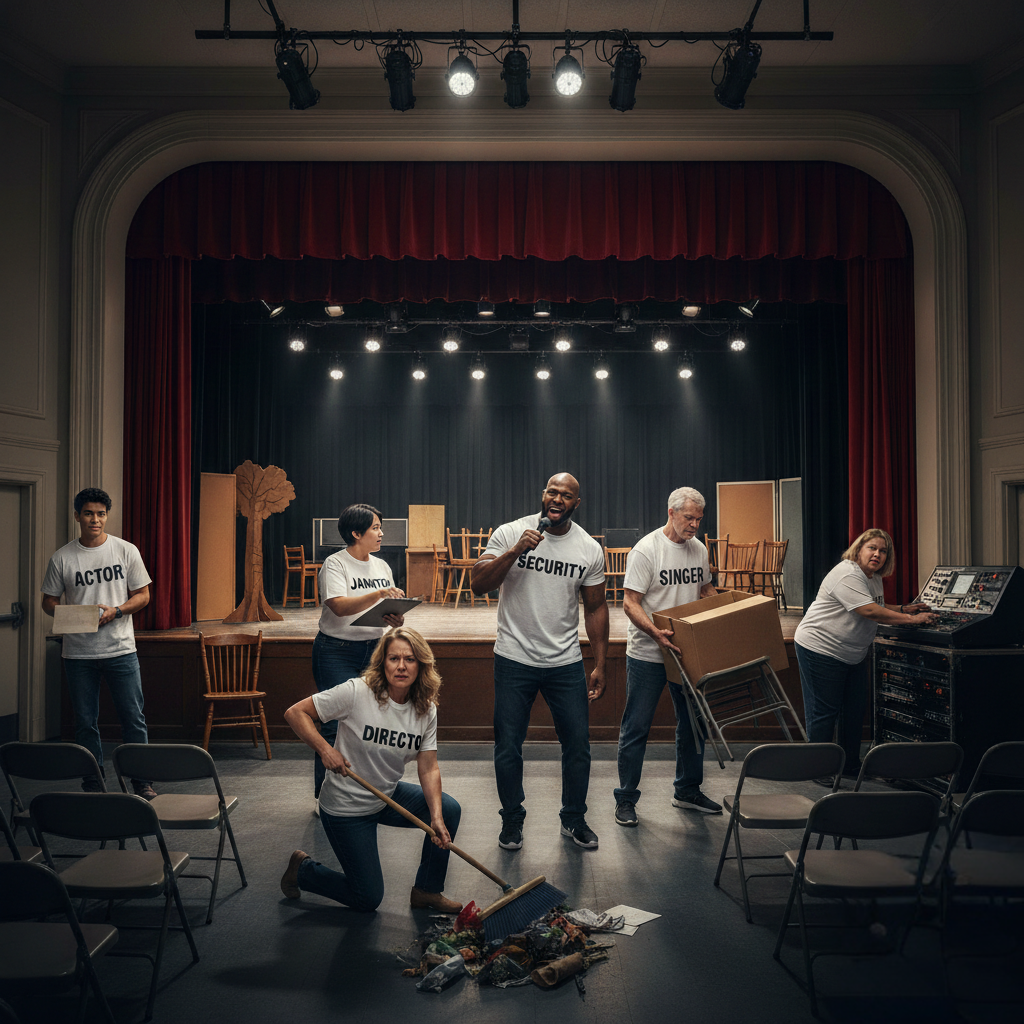
That school play was one production, but it required many people in many different positions to be successful. Some were on stage. Others worked behind the scenes, building sets, running lights, managing sound, or organizing props. Every role mattered. Without the people no one saw, the people on stage would have had nothing to stand on, nothing to perform with, and no production at all.
The Apostle Paul addresses this exact principle in 1 Corinthians chapter 12 when he speaks about the body of Christ. He explains that believers make up one body with many members, each with different functions. The problem arises when members of the body stop focusing on what God has called them to do and start focusing on what they want to do.
Paul uses practical examples. He says if everyone were an eye, how would the body hear? If everyone had a hand, where would the walking come from? Each part has a purpose, and no part exists just for decoration.
Often, when we think about the body, we focus on the outward parts. The eyes, the hands, the feet, and the physical appearance that people notice. People compliment eyes, facial features, or athletic builds. These are external things that can be seen and admired.
But here is the reality. While body parts are valuable, most are not vital to survival. There are people who have lost their eyesight, lost their hearing, or even lost limbs, and yet they continue to live. Life goes on, even though something visible is missing.
Now think about the internal parts of the body. No one compliments someone’s liver or pancreas. No one says they admire how healthy someone’s kidneys look. Those parts are never seen, but they are absolutely essential. Without the heart pumping blood, without the lungs bringing oxygen, without the liver filtering toxins, the body shuts down completely.
The unseen parts are vital.
Paul continues in 1 Corinthians 12 by discussing the different gifts God has given within the body of Christ. Apostles, prophets, evangelists, pastors, and teachers are mentioned, but Paul also includes something often overlooked. He mentions helps.
That one word is easy to skip over, but it carries incredible weight. Helps.
In the church world, people often focus on visible roles. The preacher. The pastor. The evangelist with the microphone. The prophet with the powerful words. These roles are important, and they matter to God. But they are not more valuable than the gift of helps.
Helps is what keeps the body functioning.
I once saw a pastor make a humorous yet powerful video that illustrated this point. He began standing in the pulpit, ready to preach. Then, suddenly, he noticed cars pulling into the parking lot. He stepped away, put on a parking vest, and started directing traffic.
Then he ran back to the pulpit, only to realize there was an issue with the sound system. So he left again to adjust the audio. Then, as people walked into the building and needed help finding seats, he stepped into the role of an usher. This continued again and again.
The point was clear. Without the helps ministry, everything falls apart. The sermon never gets preached. The service never flows. The experience never reaches its full potential.
Many of the most important people in the church are never seen. They unlock doors, clean bathrooms, manage finances, pray quietly, set up chairs, and serve faithfully without applause. Yet without them, the church cannot function.
As the body of Christ, we have to be where God tells us to be. We have to get into position.
When the body is in position, it works properly. When parts are out of position, problems arise. Think about the human body again. What if the liver decided it wanted to be the heart? What if the heart wanted to function like the kidneys? That body would not survive. Chaos would follow.
Sadly, this is what happens spiritually when believers try to force themselves into roles God never assigned to them. People chase titles instead of callings. They chase platforms instead of purpose. They chase visibility instead of obedience.
When that happens, not only is the body of Christ affected, but the world is affected too. We are called to be salt and light. We are called to overcome the world. But effectiveness comes from obedience, not ambition.
God does not measure success the way we do. He does not ask how visible we were. He asks how faithful we were. He does not ask how many people applauded us. He asks whether we did what He told us to do.
If you are not called to sing, do not sing. If you are not called to be on the front stage, do not force yourself there. There is no shame in being a stagehand. In fact, the stagehand makes the performance possible.
Every role matters. Every position matters.
One day, we will stand before God, and He will not ask us why we were not someone else. He will ask us whether we were faithful to what He entrusted to us. Did we obey? Did we serve? Did we stay in position?
So, take inventory. Ask God where He has placed you. Ask Him what He has called you to do. Then commit to doing that with excellence and humility.
When the body is in position, it moves with power. When the body is in position, it functions in unity. When the body is in position, it becomes unstoppable.
It is time to stop comparing, stop striving, and stop forcing doors God never opened.
It is time to get into position.
G. Edward Wyche